Help your students get the most out of “Magic: A Fantastical Stage Comedy”
Go here to find out about our live performance of MAGIC in Rochester NH, April 12-13 2024
As the Director / Producer of Chesterton Stage Productions, I love it when we get to do a play by G.K. Chesterton himself. We are once again presenting his first play “Magic: A Fantastic Comedy.” This is a show with zany characters, funny banter, and themes touching on our relationship with others and with God the spiritual realm. With all of that, I wanted to put together information about what I have been researching for the show so that theatergoers, home-school families, and other educators can get even more out of the performance.
Who is G.K. Chesterton?
Chesterton was a full of life writer. He lived in England from 1874 – 1936. He wrote everything. Fiction, biography, history, Theologies and more. He even owned his own newspaper that mostly sold for his serialized “Father Brown Mysteries.” Outside of witty quotes on the internet, GK Chesterton is probably best known today for Neil Gaiman and Terry Pratchett dedicating their book to him and for GK writing the book (The Everlasting Man) that lead to the conversion of C.S. Lewis. Lewis’ fiction could safely be described as “George Macdonald” stories with “GK Chesterton” characters. Even Lewis’ book “Mere Christianity” is his version of Chesterton’s “Orthodoxy.” Though Lewis is most famously linked; Chesterton’s influence is plainly seen and praised in the works of other artistic Christians such J.R.R. Tolkien and Rich Mullins. If you just want to get a feel for Chesterton’s work you could start with his essay collection “CHESTERTON’S GATEWAY: 14 ESSAYS TO GET YOU HOOKED ON CHESTERTON” This will give you a real feel for, not only his ideas, but his skillful wit and defining use of paradox to make points. If you would like to get right to his stories, You could sample his short mysteries from his Father Brown series. If you would like to dive right into his novels, I would suggest my two favorites “The Man Who Was Thursday” or “Manalive”
What is Magic?
Chesterton’s work finally branched into theater in 1913 after his friend and philosophical rival, George Bernard Shaw finally persuaded him to write a play. Magic is a fairy tale set in, then modern, England. The play was a huge hit in London and then came to America where it was also a smash in New York. Like C.S. Lewis after him, most of Chesterton’s work builds on each other. Most of his characters in his fiction are built from philosophies and ideals he talks about in his essays and theologies. For “Magic” you can find most of the themes and ideas that the story is built on and the characters wrestle with in the first 3 chapters of “Orthodoxy” specifically focusing on Chapter 3 “The Ethics Of Elfland.” This chapter also seems to be the basis for J.R.R. Tolkien’s essay “On Fairy Stories.” Of course, C.S. Lewis also has a lot to say about fairy tales, and he explains the idea of modern fairy tale in the introduction to his Space book “That Hideous Strength.” (You should be able to read the “intro” in the Kindle sample.) [Of course, you could also just read the actual play “Magic”, but that would include “Spoilers.”]
There are a small group of characters in the story. Like you find in Lewis’ work, the characters feel real but, at the same time, are the personification of philosophies and ideas that Chesterton is working out in his other books and essays. You also find a lot of paring of characters to compare and contrast.
Who Are the Characters?
All the action takes place in the house of the Duke. He is very “modern” to the point that he simply supports both sides of everything. As the most cartoonish of the characters, the Duke brings together the strange circumstances of the play. Then there are two guests of the house; old Doctor Grimthorpe from next door and the young parish priest, Smith. The priest loves a “friendly argument” and thus becomes a great sparring partner for the Doctor who takes an immediate liking to the young pontiff and disagrees with him on most points. This also gives the Duke plenty of opportunity to be “Broad Minded” on many subjects. The Duke’s two young wards are also joining them. Patricia is straight from their native Ireland. She brings that magical land with her as she spends her time in poetry and sees fairies in the yard. Her brother Morris had moved on from his homeland to live in America. Returning to England, Not only has Morris become a high-powered player in American Oil, he has fully assimilated to the American industrial west and knows his sister should not be so frivolous in her beliefs because he believes there is nothing beyond the physical world. The Duke, wanting to provide for everyone, brings in a Conjurer so that Patricia can see magic and Morris can see through it. Then the Conjurer himself seems to have an interest in Patricia. This incites her brother, Morris, to attack the Conjurer even more viciously.
This is what I love about Chesterton; his stories are fun and wild and his cast of characters are prime for a comedy skirmish as well as bringing out deep ideas and concepts.
What about the Time-Period?
This play took place in 1913. It was a very interesting time in England. Travel at that time was very open and well to do people were often all over Europe, or even “across the pond.” So, having a house with people from England, Ireland, and America was not uncommon. It was a time of great prosperity for the upper class and thus there was more time for all types of activism. Woman’s suffragettes were demonstrating across England and one commentator said that we should not be fooled by these demur girls, they may be holding a Molotov-cocktail under their distinctive white dress. There was also lots of entertainment. There were great theaters and shows. (George Bernard Shaw was HUGE at the time.) It was also common for large houses to host shows. An interest in the supernatural and tricks lead to an influx of Magicians and Conjurer’s. Most notably, Harry Houdini was impressing audiences with his illusions as well as exposing “spiritualist” doing séances. (It fits well with the play that Houdini is American.) The phrase “Parlor Tricks” comes from the common occurrence of Conjurer’s being brought in as entertainment for large groups at private houses.
Since 1913 was the year right before England entered World War One, it is easy to find information on it. Charles Emmerson’s “1913: In Search of the World Before the Great War” is an obvious choice. The BBC also put together a series of podcast reports that are very interesting.
Questions for the Way Home:
It’s always great to just start with “What did you think?” “Did you like it?” “What stood out to you?” Often these are enough to really get into a deep conversation. Other questions that go with most shows are to ask about the period compared to now, what would these characters be like today? What do they think happens to each of the characters after? Whom would you most want to hang out with? With this play, it’s great to look at character traits and their positions, but then see how they are paired. Chesterton’s love of presenting paradox makes it possible to see more of the story by comparing any two characters. Some of the major comparisons are the Priest and the doctor / The triangle of Patricia, Morris, and the Conjurer / The Priest and the Conjurer / even the Duke (separating people and demeaning opinions by taking both sides) compares with the Priest and the Doctor (who believe very firmly in taking sides and it builds relationship and increases some understanding.) Finally, Magic is presented as a fairy tale; How does it compare to “classic” fairy tales? And What is this saying about fairy tales?
Hope to See You There!
We are very excited to present a fun story with depth and heart. I hope this helps you get even more out of Magic: A Fantastical Stage Comedy. Ticket information is coming soon. We will be performing April 12-13 at the Heritage Chapel Stage (next to Emmanuel Church in Rochester NH) .

Go here to find out about our live performance of MAGIC in Rochester NH, April 12-13 2024
See what we are doing at Chesterton Stage Productions.
Need a mug and a shirt for the show?
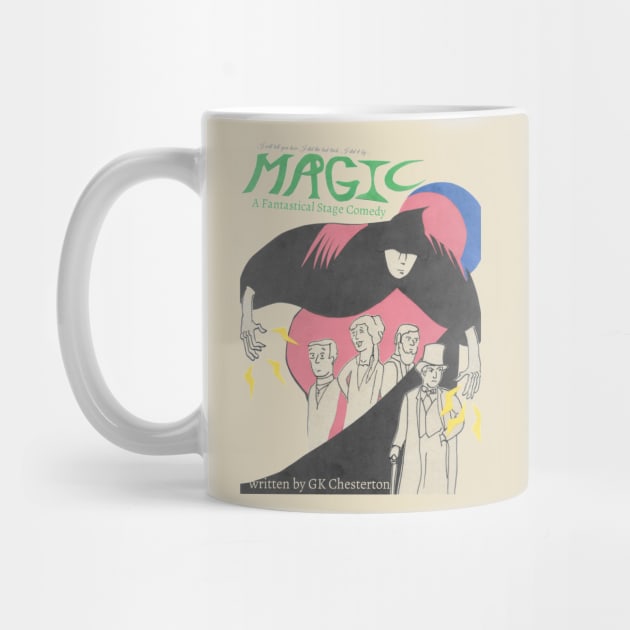
Remember it’s “Bring Your Own Tea Cup” for tea time during intermission!
You can download a printable version to use with your students or other educators: Here
(Had The two heroes read Donald Miller’s “Scary Close” this conflict would not have happened.)
 Chesterton Stage Productions